The relational model and relationships
Turn real-world concepts into related tables with keys and clear relationship rules.
From entities to tables
Begin by identifying the things the application needs to remember. In a shop, customers, products, and orders are entities. Each entity has attributes: a customer has a name and email; a product has a name and current price.
A table represents one kind of entity, a row represents one record, and a column represents one attribute. A primary key identifies a row. A foreign key points from one table to a key in another table, expressing a relationship and allowing the database to enforce that the referenced row exists.
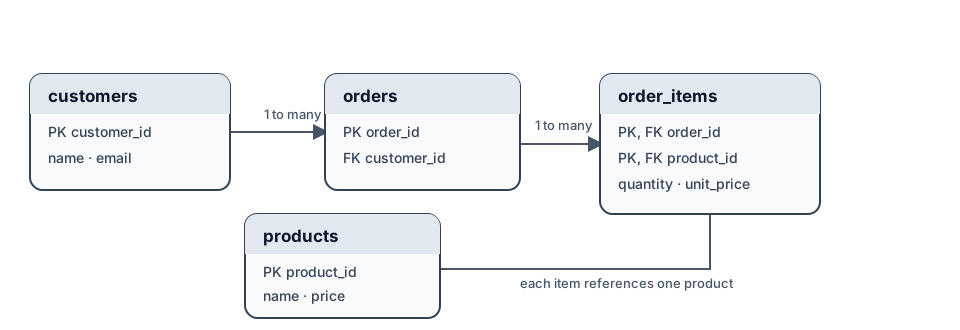
The diagram's one-to-many relationships follow the relational modeling and foreign-key concepts in the PostgreSQL tutorial.
Relationship patterns
- One-to-one: one account has one profile. A unique foreign key can enforce this.
- One-to-many: one customer can place many orders. Put the customer key on each order.
- Many-to-many: an order can contain many products, and a product can appear in many orders. Represent the relationship with a linking table such as
order_items.
The linking table can also hold facts about the relationship, such as the quantity and price captured when a product was purchased. This is why order_items is more than a technical bridge.
Keys and good identifiers
Use a key that is stable and unique. A generated numeric identifier is convenient for internal references; a real-world attribute such as email can still have a UNIQUE constraint when the business rule requires it. Do not assume a customer's email or name will never change.
Exercise: Sketch tables for a library with books, authors, and loans. Which relationship needs a linking table if a book can have multiple authors?
Sources: PostgreSQL: Foreign Keys, GeeksforGeeks: DBMS Tutorial