Briefing and delegation
Turn a vague request into a bounded assignment an AI assistant can complete and you can review.
From asking to delegating
A chat answer is usually a response to a question. A delegated task asks an assistant to produce a work product: a draft report, a comparison, a spreadsheet, or a first version of a presentation. The supplied video frames this as briefing an assistant like a new colleague. The useful lesson is to transfer the context you already hold in your head before the work starts.
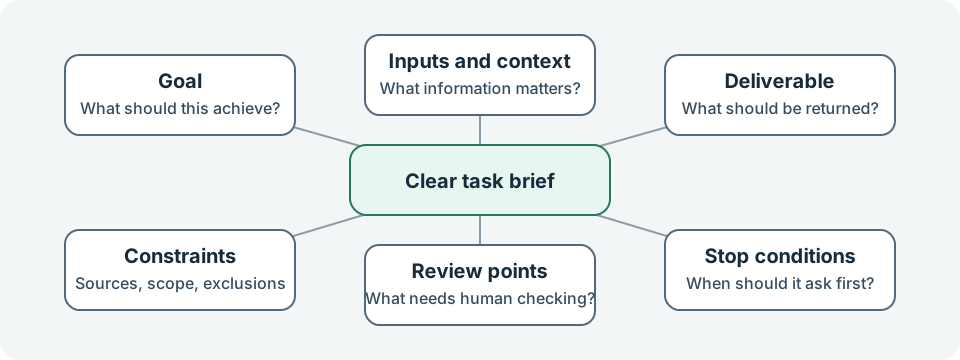
A practical brief answers:
- Goal: What decision or need should this support?
- Inputs: Which files, systems, or links are relevant?
- Context: What background and audience matter?
- Deliverable: What should be returned, and in what format?
- Constraints: What sources, tone, length, deadline, or exclusions apply?
- Review points: What must the assistant ask before doing, and what will you verify?
For example: “Using the attached anonymized survey CSV and the question list, draft a one-page summary for the product team. Include three evidence-backed themes and a small table of counts. Do not infer causation. Link each finding to a row range. If categories are ambiguous, list questions instead of guessing. Save a draft only; do not send it.”
Bound the task
Large open-ended assignments make it harder to detect missing information. Break them into clear stages: inspect inputs, propose an outline, produce a draft, then revise after review. Specify when to stop and ask. Avoid connecting confidential records or granting action permissions unless the task requires them and your organization permits their use.
Exercise: Choose a recurring task. Write a brief with the six elements above. Mark at least one condition where the assistant must stop and ask.
Sources: Supplied video transcript